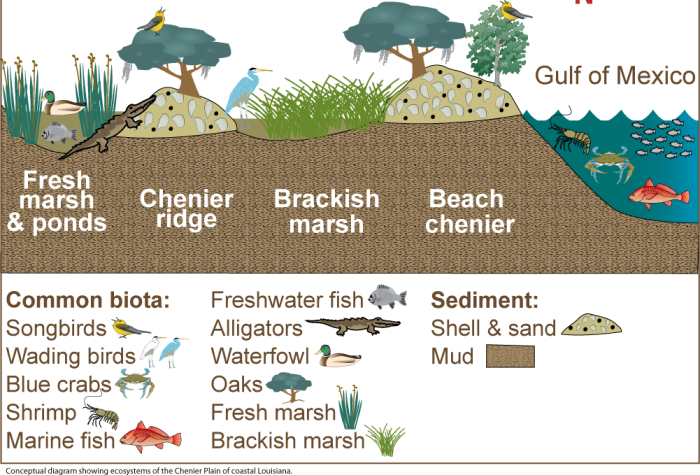
Along the edge of the Gulf in Southwest Louisiana, the landscape shifts between wide marshes, winding bayous, and narrow ridges of slightly higher ground known as cheniers. Travelers along the Creole Nature Trail All-American Road may notice these ridges rising just a few feet above the surrounding marsh, often marked by stands of live oak, hackberry, and other various shrubs and trees which appear as an island in a sea of marsh grasses. Though subtle in appearance, these cheniers play a crucial role in the health and resilience of Louisiana’s coastal ecosystem.
The Formation of the Chenier Plain
The name “chenier” is derived from the Louisiana French word for these formations — “chênière" — meaning oak-grove, referring to the forests of live oaks that occupy the chenier ridges. The Chenier Plain region of the northern Gulf of Mexico extends some 200 miles from Vermillion Bay westward to East Bay near Galveston, Texas.
Cheniers are actually ancient gulf beaches stranded inland by the historic deltaic processes of the Mississippi River and erosion. Early colonial inhabitants of the Chenier Plain region discovered what Native Americans had found long before them; a land rich in natural resources, teeming with fish and wildlife.
The majority of the prehistoric sites found in the area date to what is known as the “Coles Creek” Period (A.D. 400 to A.D. 1100). The Coles Creek settlement pattern was one of villages and mounds on the cheniers with numerous small fishing and hunting camps dispersed throughout the surrounding marshes, along bayous, lakes and bays in the area.
Why Cheniers Matter for Bird Migration
Each year, millions of migrating birds cross the Gulf of Mexico during spring and fall migrations. After hours of nonstop flight over open water, many birds reach the Louisiana coast exhausted and in urgent need of food and shelter.
Cheniers provide exactly that; the tree-covered ridges act as resting and feeding refuges, creating vital stopover points for migrating songbirds, raptors, and waterfowl. Without these pockets of elevated forest habitat, many birds would have nowhere to land along the marshy coastline. As a result, cheniers help support one of the most significant bird migration corridors in North America.
Cameron Parish sees over 400 species of birds throughout the year; this large variety of birds attracts birdwatchers and nature enthusiasts from around the world. Each season brings a new set of birds to the area, with spring and fall dominated by migrating songbirds, shorebirds, and raptors, and the winter months being the best for waterfowl viewing.
How Cheniers Support the Coast
Beyond their role in bird migration, cheniers also contribute to the stability of the coastal environment. The vegetation and shell-rich soils help slow erosion and provide a natural buffer against wind and storm energy. Louisiana’s coastal wetlands already serve as a critical first line of defense against hurricanes and storm surge, absorbing wave energy and reducing inland damage.
Cheniers strengthen this system by adding structural diversity to the coastline and helping anchor surrounding marshes, and they help sustain one of the most productive ecosystems in the country. The surrounding marshes create the fertile base for a complex food web that supports fish, shrimp, crabs, birds, and mammals. Without the coastal cheniers, the wetlands would not be the same.
How to Protect Coastal Cheniers
Despite their importance, cheniers and the wetlands around them face serious threats. Coastal erosion, subsidence, altered river systems, and climate-driven sea level rise are steadily reshaping Louisiana’s shoreline. Preserving these landscapes requires both large-scale restoration efforts and responsible visitation.
Anyone exploring the region—especially along the Creole Nature Trail—can help protect this fragile environment by following one simple rule: Pack in what you need and pack out anything you bring with you. Protecting the flora, fauna, and natural beauty of the coastal marsh ensures that future generations can experience this remarkable ecosystem for themselves.
Cheniers may appear to just be small hills in a vast expanse of marsh, but their importance is immense. They serve as lifelines for migrating birds, anchors for coastal wetlands, and quiet guardians for one of America’s most valuable natural landscapes.